Types of campus drives: on-campus, pool and off-campus, and when each one fits
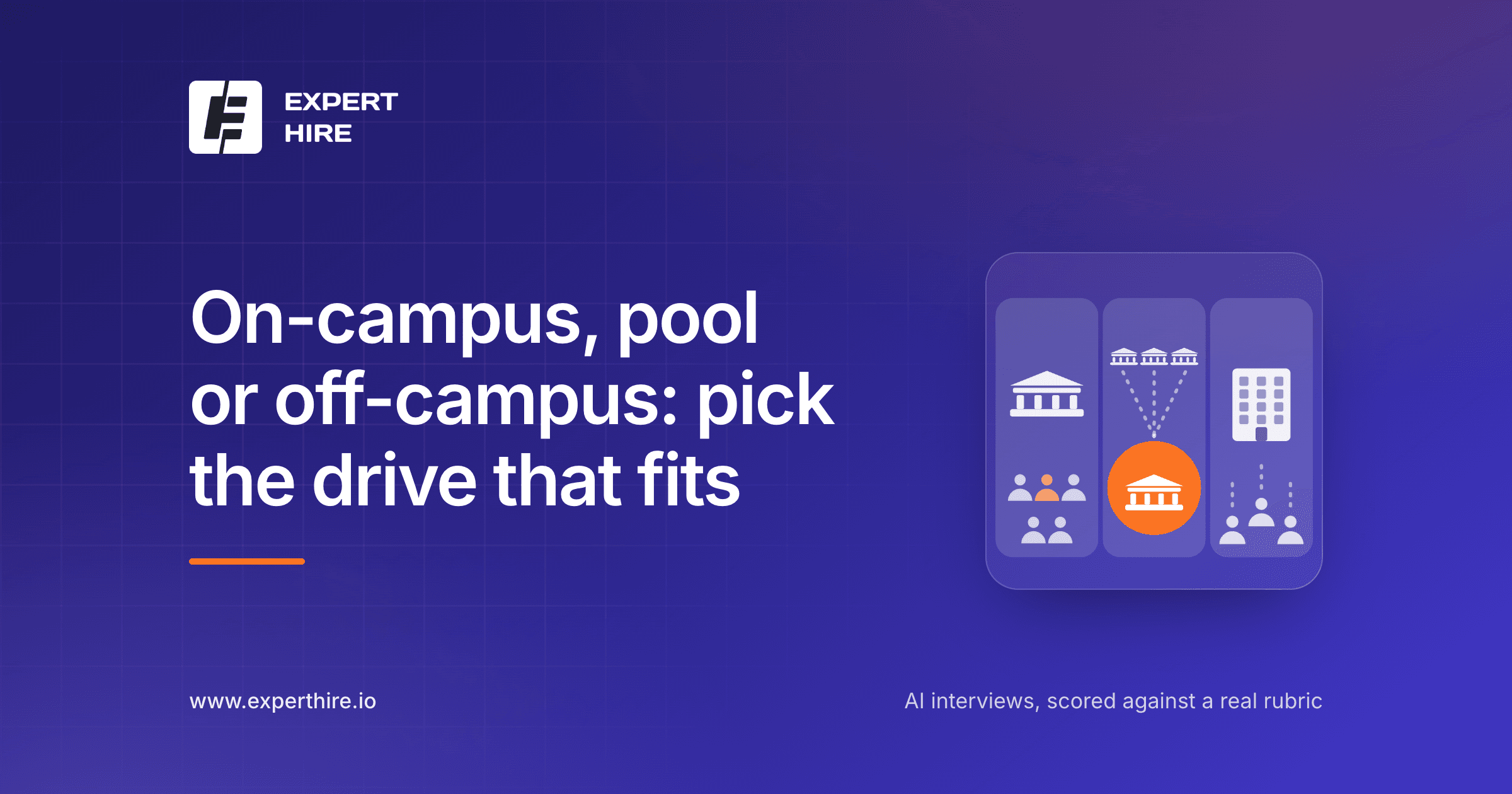
There are three main types of campus drives. In an on-campus drive, one company recruits at one college through its placement cell. In a pool campus drive, students from several colleges sit one shared recruitment process at a host venue. In an off-campus drive, the company recruits directly and students apply without their college.
Most explanations stop there, and most are written for students. This one is for the two people who actually choose the format: the campus hiring lead at a company and the training and placement officer at a college. If you're new to campus recruitment as a whole, start with our explainer.
Key Takeaways
Our position: pick the drive type by what you're short of. On-campus gives you control, pool drives give you reach across colleges, and off-campus gives you the widest reach with the least control.
On-campus drives work best at colleges that have already sent you students who joined and did well.
A pool campus drive is the practical way to hire from tier-2 and tier-3 colleges, but only if you can compare students from different colleges on one rubric.
Off-campus drives bring the most applicants per seat, so the first round has to be cheap to run and fair to score.
Virtual drives and pre-placement offers (PPOs) are variants of these three, not separate types.
Types of campus drives at a glance
Every campus drive answers three questions: who organises it, who can attend, and whose rules apply. Here's how the three types answer them.
On-campus drive: the company and one college's placement cell run it together. Only that college's eligible students attend, and the college's placement policy applies.
Pool campus drive: a host college, a university or a placement officers' association runs it. Students from several colleges attend one shared process.
Off-campus drive: the company runs it alone. Any student who meets the criteria can apply, and no college policy applies.
A few facts frame the choice:
The Telangana Training & Placement Officers Association describes pool drives as bringing "together students from multiple colleges at a common venue for recruitment", with the association coordinating between companies and colleges.
India's NIRF engineering framework gives 40 of 100 graduation outcome marks to a combined placement and higher-studies metric, and 25 to median salary. Colleges track which drives produce joiners for a reason.
In NACE's 2024 US data, about 7% of accepted offers to new graduates ended in a renege. That's US data, but it's a reminder that the format matters less than what happens after the offer.
On-campus drives: one company, one college
An on-campus drive is the classic format. The company agrees a slot with the placement cell, gives a pre-placement talk, then runs tests and interviews for the college's eligible students, usually over a day or two.
For employers, the appeal is control. You know what you'll get. You know the college, you know the curriculum, and if you've hired there before you know how its students perform after joining. The cost is reach: one visit gets you one college's batch, and a dedicated drive at a college with a small eligible pool rarely pays for itself.
For the placement cell, this is the format it controls most. The cell sets eligibility, such as minimum CGPA, allowed branches and batch years, and applies its own offer policy. Our guide on how a placement cell runs a campus placement drive covers that work step by step.
Choose on-campus when a college has a track record of students who accepted, joined and stayed in your role family.
Pool campus drives: several colleges, one process
So what's the pool campus drive meaning in practice? A pool campus placement drive brings students from several colleges into one recruitment process. A host college, a university or an association like TTPOA organises it, invites nearby colleges, and runs the tests and interviews at a central venue or online.
For employers, a pool campus drive is a way to reach students at colleges you'd never visit one by one. One process can cover a dozen campuses. TTPOA, for example, lists IT, engineering, banking and manufacturing firms among the companies at its pool drives.
The hard part is fairness across colleges. Students come with different grading scales and different prep, so CGPA alone won't compare them. You need one structured first round, scored on one rubric, for every student. That's the evaluation problem a campus hiring solution should solve.
It can work. In one Expert Hire case study, a team ran structured screens with shared rubrics across every campus, and said the drive "felt like one pipeline instead of five disconnected ones".
For the host cell, the job is to coordinate. Agree up front whose offer policy applies, how many offers a student can hold, and who sends results to each college. Write it down before the first test, because disputes after offers are much harder to settle.
Off-campus drives: the company runs it, students apply directly
An off campus drive is run by the company with no placement cell in the loop. Students find the opening on a careers page or a job board, apply on their own, and go through the company's process. Recent graduates and students from colleges the company doesn't visit often apply this way.
For employers, it's the widest reach and the least control. You'll get far more applicants per seat than any campus visit, and many won't meet the bar. So the first round has to be cheap to run, quick to score and the same for everyone.
For students, the trade-off is simple. Off-campus drives are open to anyone eligible, but no cell is negotiating on their behalf, and no college offer policy protects them. If you've searched "on campus vs off campus placement", that's the core difference: who runs the process, and whose rules apply.
Virtual drives and PPOs: variants, not separate types
Two other terms come up often, and both are variants of the three types above rather than types of their own.
Virtual drives. Any of the three can run online, fully or for the first round. A virtual pool drive is still a pool drive. Our post on virtual campus hiring covers how to design remote rounds.
Pre-placement offers. A PPO turns a summer internship into a full-time offer, often before the drive season starts. Whether it counts as a placement is a policy choice each cell makes. Expert Hire's college settings include an optional PPO exemption, off by default, under which a PPO "does not count as a placement" though the offer cap still applies.
Which drive type to choose
The right type depends on your side of the table and what you're short of.
For employers:
Short of quality you can predict? Go on-campus at colleges with a proven record in your role family.
Short of volume? Join or request pool drives across tier-2 and tier-3 colleges, and bring a shared rubric.
Short of reach, or hiring outside the season? Run an off-campus drive with a structured first round.
Not sure yet? Choosing the format is a planning decision. Our campus recruitment process guide puts it in phase 2, once headcount and rubrics are set.
For placement cells:
Host a pool drive when nearby colleges together can offer a company a batch worth the trip, and you have the staff to coordinate.
Join a pool drive when companies won't visit your campus alone. It's often the fastest way to reach new recruiters.
Hold out for on-campus when a recruiter has hired from you before and wants your batch specifically.
Whatever you choose, record every drive, applicant, offer and joining date in one place. It's what you'll need for the season review and your NIRF return.
Frequently asked questions
What is a pool campus drive?
A pool campus drive is a recruitment drive where students from several colleges take part in one shared process, usually at a host college or a central venue. A host college, a university or a placement officers' association organises it, and one or more companies recruit from the combined pool.
What is the difference between on-campus and off-campus placement?
In on-campus placement, the company recruits through a college's placement cell and the college's policy applies. In off-campus placement, the company runs the process and students apply directly, with no cell involved. On-campus is more controlled; off-campus is more open.
Who can attend a pool campus drive?
Students from the colleges the organiser invites, as long as they meet the company's eligibility criteria, such as branch, batch year and minimum CGPA. Each participating college usually registers its eligible students. Check with your own placement cell before the drive.
Is an off campus drive harder than an on-campus drive?
Usually, yes, because more people apply for each seat and no placement cell screens or supports you. The rounds themselves can be similar. Strong preparation for tests and interviews matters more off-campus, because there's less of a shortlist in front of you.
Does a pre-placement offer count as a campus placement?
It depends on your college's policy. Some cells count a PPO as a placement, while others treat it separately because it comes from an internship already served. Ask your placement cell how it treats PPOs before you accept one.
The bottom line
The types of campus drives aren't a ranking. On-campus buys control, pool drives buy reach across colleges, and off-campus buys the widest reach at the lowest control. Choose by what you're short of, and plan the first round so every student is scored the same way.
Expert Hire is an AI interview platform that employers use to run one structured first round across many colleges, and that placement cells use as a free placement management ERP plus paid student practice. If you run a placement cell, see how the free placement ERP works.
By TK, Growth at Expert Hire. Last updated October 27, 2026. Reviewed by Anand Suresh, CPO at Expert Hire.
Ready to Transform Your Hiring?
Start your free trial to see how Expert Hire can help you screen candidates faster and smarter.