JavaScript interview questions that separate real skill from recall
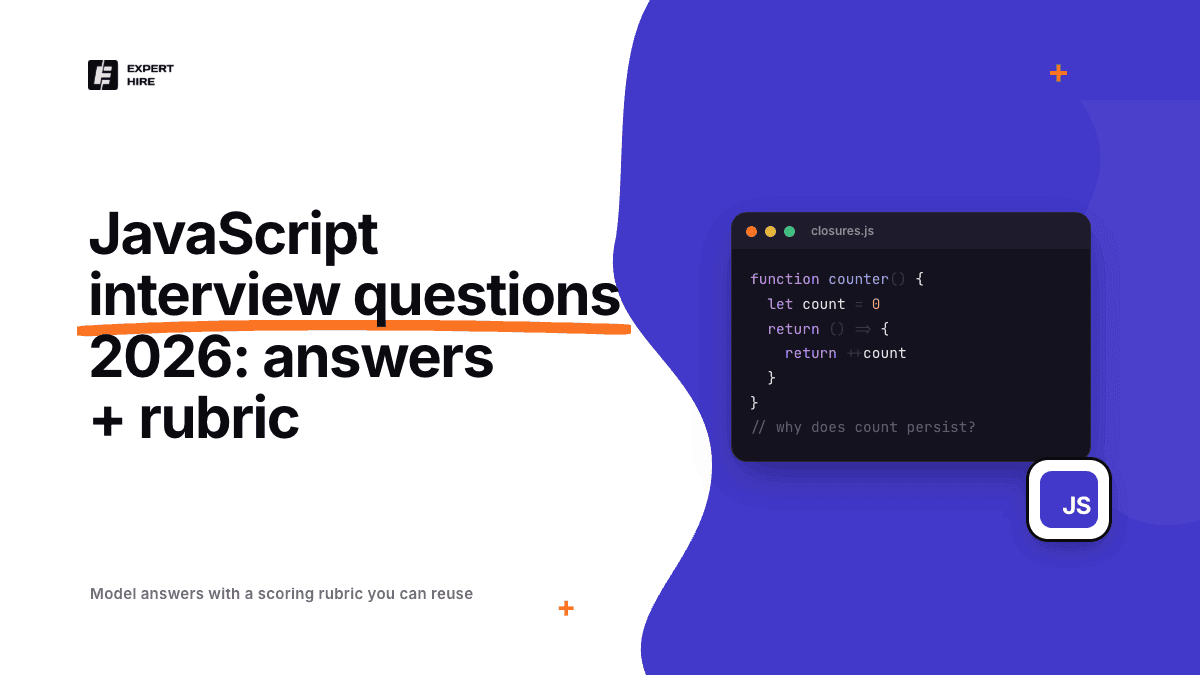
JavaScript interview questions should test whether a candidate understands the parts of the language that actually bite: closures, this, prototypes, and the event loop. Anyone can define let versus var; far fewer can explain why a loop with a callback logs the wrong number.
This guide levels the questions by seniority, gives a model answer for each, and adds a one-line scoring note so you can run the screen even if JavaScript is not your stack.
The web is full of JavaScript interview questions and answers, some lists a thousand items long. This one is built for both sides of the table. Candidates prep from the model answers; hiring managers and recruiters use the scoring notes to tell real understanding from a memorized top javascript interview questions list.
Key Takeaways
The most predictive JavaScript questions are closures, this, prototypes, and the event loop, because they test the language's actual behavior rather than surface syntax.
Level on purpose: juniors explain types and scope, mid-levels reason about closures and this, seniors reason about async, the event loop, and performance.
Score the reasoning, not the keyword. "Strong answer explains why the closure captures the variable, not its value at call time; weak answer just says closures remember scope" is the rubric.
ES6+ fluency is now a baseline signal for whether someone writes modern JavaScript or 2015-era code.
A structured, rubric-scored first round predicts performance far better than an unstructured chat. Schmidt and Hunter put structured interview validity at about 0.51.
What JavaScript interview questions actually test in 2026
A JavaScript interview tests the mental model, not the API surface. The javascript interview questions 2026 hiring teams ask increasingly focus on behavior over syntax: how values are typed and coerced, how scope and closures work, how this is bound, how prototypal inheritance works, and how asynchronous code runs on a single-threaded event loop. At senior level it tests judgment: async patterns, performance, and memory.
The questions below are grouped by seniority with a model answer and a scoring note each. The scoring note is what lets a non-JavaScript interviewer run the screen, because it names what a strong answer covers versus where a weak one stops.
Junior-level JavaScript questions
These confirm the fundamentals. A junior hire must understand types, scope, and the classic coercion traps.
What is the difference between == and ===? === checks value and type with no coercion; == coerces the operands to a common type before comparing, which produces surprising results (an empty string equals zero, for example). The practical rule is to use === by default and reach for == only deliberately. Understanding why == is dangerous matters more than memorizing its rules. Scoring note: Strong answer names type coercion as the reason and defaults to ===. Weak answer says one has "three equals" without explaining coercion.
What is the difference between var, let, and const? var is function-scoped and hoisted, which causes bugs; let and const are block-scoped. const prevents reassignment of the binding, though the object it points to can still be mutated. Modern JavaScript uses let and const and avoids var. Scoring note: Strong answer distinguishes function vs block scope and notes const locks the binding, not the object. Weak answer thinks const makes objects immutable.
What is hoisting? Hoisting is JavaScript moving declarations to the top of their scope before execution. var declarations are hoisted and initialized to undefined; let and const are hoisted but not initialized, so accessing them early throws (the temporal dead zone). Function declarations are hoisted whole. Hoisting explains a lot of "why is this undefined" confusion. Scoring note: Strong answer distinguishes var hoisting from the temporal dead zone. Weak answer says "declarations move to the top" with no nuance.
Mid-level JavaScript questions
These test the parts most candidates get wrong: closures, this, and prototypes. A mid-level engineer should reason about them, not just recognize them.
What is a closure, and give a real use for it? A closure is a function that retains access to variables from the scope where it was defined, even after that scope has returned. Real uses include data privacy (variables no one outside can touch), function factories, and preserving state in callbacks. The classic bug is a loop with var where every callback closes over the same variable, which is why let fixed it by creating a new binding per iteration.
Scoring note: Strong answer gives a concrete use and knows the loop-variable trap. Weak answer defines a closure but cannot say why it is useful.
How is this determined in JavaScript? this is set by how a function is called, not where it is defined. A plain call gets the global object (or undefined in strict mode), a method call gets the object before the dot, call/apply/bind set it explicitly, and new binds it to the new object. Arrow functions are the exception: they capture this from the enclosing scope.
Scoring note: Strong answer ties this to the call site and knows arrow functions differ. Weak answer thinks this is fixed by where the function is written.
How does prototypal inheritance work? Every object has a prototype, and property lookups that miss on the object walk up the prototype chain until found or exhausted. This is how methods are shared without copying them onto every instance. ES6 class syntax is sugar over this prototype mechanism, not a separate model.
Scoring note: Strong answer describes the prototype chain and knows class is sugar. Weak answer treats JavaScript classes as classical inheritance.
Senior-level JavaScript questions
These test judgment: the event loop, async patterns, and performance. A senior answer reasons about how asynchronous code actually runs.
Explain the event loop. JavaScript runs on a single thread with an event loop. Synchronous code runs first; asynchronous callbacks wait in queues. After each synchronous run, the loop drains the microtask queue (resolved promises) before the macrotask queue (timers, I/O callbacks), which is why a resolved promise runs before a setTimeout of zero. This is the model behind every "why did this log in that order" question.
Scoring note: Strong answer distinguishes microtasks from macrotasks and gives the promise-vs-setTimeout ordering. Weak answer says "JavaScript is asynchronous" with no mechanism.
Compare callbacks, promises, and async/await. Callbacks are the lowest level and nest badly. Promises represent a future value and chain cleanly, avoiding nesting. async/await is syntactic sugar over promises that reads like synchronous code, with normal try/catch for errors, while still yielding to the event loop under the hood. All three are non-blocking.
Scoring note: Strong answer notes async/await is built on promises and still non-blocking. Weak answer thinks await blocks the thread.
What causes memory leaks in the browser, and how do you find them?
Common causes are listeners never removed, timers never cleared, detached DOM nodes still referenced, and closures that retain large objects. You find them with heap snapshots taken over time, looking for object types that keep growing, then tracing what retains them. The senior signal is naming concrete sources, not just "the garbage collector missed something."
Scoring note: Strong answer names concrete leak sources and the heap-snapshot method. Weak answer assumes JavaScript cannot leak because it is garbage collected.
ES6+ and modern JavaScript questions
Modern-JavaScript fluency separates current engineers from ones who stopped learning years ago. These es6 interview questions check for it.
Which ES6+ features do you reach for most, and why? Strong answers cite destructuring and spread for cleaner data handling, arrow functions for concise callbacks and lexical this, template literals, async/await for readable async code, and modules for structure. The point is not listing features but explaining the problems they solve. A candidate who still writes everything in ES5 style is a signal worth probing.
Scoring note: Strong answer ties features to the problems they solve. Weak answer lists syntax with no intent.
Coding questions and how to run them
For javascript coding interview questions, keep the exercise small and observational: implement debounce, flatten a nested array, or write a function that fixes the classic loop-closure bug. Watch how the candidate reasons out loud, handles edge cases, and responds when you ask "what happens if the input is empty." A short, well-scored coding task reveals more than a long algorithm puzzle that tests memorization.
Scoring note: Strong candidates clarify requirements and handle edge cases before optimizing. Weak candidates jump to code without understanding the problem.
How to evaluate a JavaScript answer when JS is not your stack
If you are a recruiter or hiring manager who does not write JavaScript, the scoring notes are your rubric, but the sharpest signal is the follow-up. After a clean answer, ask "what would that log, and why" or "what happens under the event loop." A candidate with real experience extends the reasoning; one who studied a list stalls.
That is the gap Expert Hire's AI interview platform closes. It runs a structured JavaScript or frontend first round, asks the leveled and coding questions plus the follow-ups, and scores each answer against a published rubric, returning a scorecard with the transcript and per-question reasoning.
You do not need to write JavaScript to run a defensible JS screen. Structured, rubric-scored rounds also predict performance far better than an unstructured chat: Schmidt and Hunter put structured interview validity at about 0.51. The scoring methodology is open, and it is the same rubric logic behind every bank in our question library. For the closure and event-loop claims above, MDN Web Docs is the primary source worth mirroring.
How to practice these as a candidate
Do not memorize answers, build the model. Be able to explain why a closure captures a variable, how this is bound, and what the event loop does with a promise versus a timer, out loud, because a good interviewer follows up. Practice under light pressure with Expert Hire's practice interviews or a frontend mock interview, and prep the adjacent rounds with the sibling banks: React interview questions and Node.js interview questions.
Frequently asked questions
What are the most important JavaScript interview questions? The separators are closures, how this is bound, prototypal inheritance, and the event loop, because they test the language's real behavior rather than surface syntax. Type coercion and scope are the junior-level foundations underneath them.
What ES6 interview questions should I expect? Expect questions on let/const and block scope, arrow functions and lexical this, destructuring and spread, template literals, async/await, and modules. Interviewers use them to check whether you write modern JavaScript or ES5-era code.
What are common JavaScript coding interview questions? Common ones include implementing debounce or throttle, flattening a nested array, deep-cloning an object, and fixing the classic loop-closure bug. The goal is to watch reasoning and edge-case handling, not to test whether you memorized an algorithm.
Is JavaScript hard to interview for? The syntax is approachable, but the concepts that interviews focus on (closures, this, the event loop) are exactly the parts that take time to internalize. Most candidates handle the junior questions; the mid and senior questions are where preparation shows.
How do I run a JavaScript screen if no one on my team writes JS? Use a structured question set with an explicit rubric so evaluation does not depend on your own JavaScript knowledge, or run the round through an AI interviewer that scores against a published rubric and returns a reviewable transcript. That is the defensible path for a non-specialist team.
The bottom line
The best JavaScript interview is not the longest question list, it is a leveled set plus a small coding task where you know what a strong answer contains and you follow up until the model holds or breaks. Anyone can recite let versus var. Far fewer can explain why a closure logs the wrong number or why a promise beats a zero-delay timer. Score that.
If you want to see what a structured, rubric-scored JavaScript round looks like, look at a sample candidate scorecard and decide whether the per-question reasoning is something you would trust to advance a frontend candidate. That is the line between a question bank and a real evaluation.
By TK, Growth at Expert Hire. Last updated July 6, 2026. Reviewed by Anand Suresh, CPO at Expert Hire.
Ready to Transform Your Hiring?
Start your free trial to see how Expert Hire can help you screen candidates faster and smarter.