How to verify skills on a resume: probe them, don't look them up
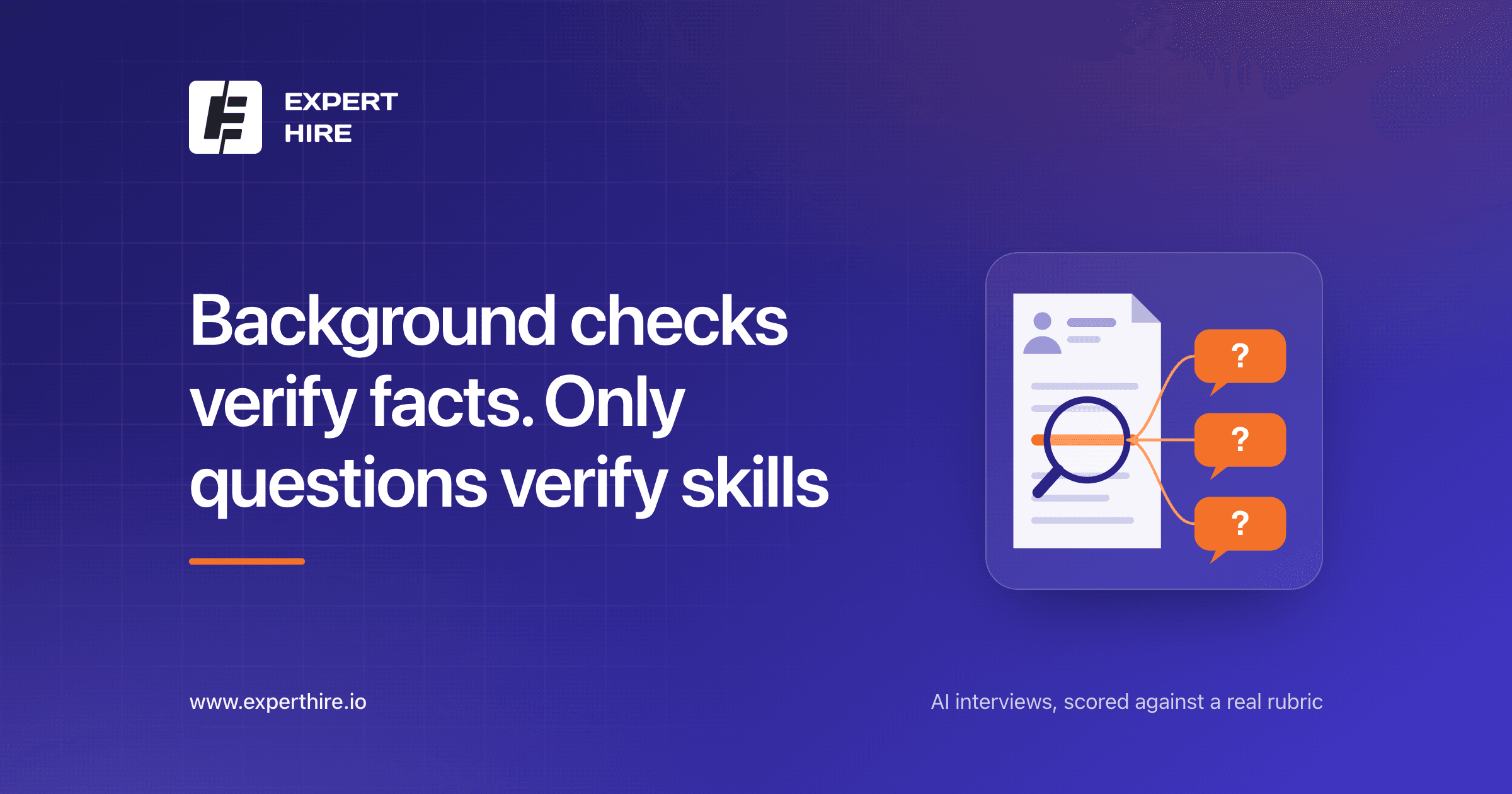
How to verify skills on a resume has a short answer: you make the candidate use them, or talk about using them at a depth only real experience supports. Skill claims like "led the migration to Kubernetes" aren't recorded in any database, so no background check can confirm them. Dates, titles, and degrees are a different job, and records handle those.
Put simply, a background check verifies that the job existed. Only an interview verifies what the candidate did in it. Most advice on resume verification covers the records half thoroughly and the skills half not at all, which is a problem, because the skills half is where inflated resumes usually live.
Key Takeaways
Our position: a background check verifies that the job existed, and only an interview verifies what the candidate did in it. You need both, and they answer different questions.
Skill and impact claims have no registry. A real claim survives three follow-ups about personal decisions, failures, and numbers, and an inflated one runs out of detail.
For hands-on skills, a work sample such as a coding test shows the skill directly instead of describing it.
Compare the resume with a recorded transcript, not with an interviewer's memory of the conversation.
Fact claims (employer, dates, title, degree, license) are checked against records, and third-party checks in the US come with Fair Credit Reporting Act consent and notice rules.
Two kinds of resume claim, and why only one has a paper trail
Before you verify resume claims, sort them. Every line on a resume is one of two things. A fact claim says something happened: "Senior Engineer, Acme, 2021 to 2024" or "BS in Computer Science". A skill or impact claim says something about the person: "five years of React", "cut p95 latency by 40%", "owned the payments service".
Fact claims leave a paper trail. Employers keep payroll records, universities keep degree records, and licensing boards keep license records. Skill claims don't. No database records who actually made the call on a migration, or whether the 40% was the candidate's work or the team's.
That's why the anxious searches around this topic, the ones asking whether a background check catches a lie, have a slightly uncomfortable answer. It catches the lies about dates and titles. It doesn't catch the lies about what someone can do.
Why references and screeners can't verify skills either
A reference can tell you the candidate worked on the payments team. It usually can't tell you whether they designed the retry logic or reviewed someone else's pull request. References are also chosen by the candidate, which tells you something about how much weight they'll bear.
Screening tools don't close the gap either. Resume screening is useful triage, and our piece on resume screening software argues for using it that way, but a screener reads the resume. It can't tell you whether the resume is true.
So the only way to verify a skill is to watch the candidate use it, or make them talk about using it in detail. That's what an interview or a skills assessment is for. It's also the logic behind skills-based hiring generally: test the skill, don't trust the label.
How to verify skills on a resume: the three follow-ups
Pick the two or three skill claims on the resume that matter most for the role. For each one, ask the candidate to walk you through it, then follow up three times.
"What did you personally decide?" Push past "we". A real owner can name the decision, the alternative they rejected, and why.
"What went wrong?" Every real project has a failure in it. Someone who did the work remembers the bad week in detail, and someone who watched it remembers the launch.
"What was the number before, and how did you measure it?" Impact claims need a baseline and a method. "Latency dropped 40%" should come with what latency was, where it was measured, and over what window.
A real claim survives all three, and usually gets more specific as you go. An inflated one runs out of detail by the second question. That's not proof of dishonesty, but it's a good reason to weight that line of the resume less. Our guide on how to conduct a technical interview covers the structure around these questions.
When to add a skills test instead of more questions
Talking about a skill and using it aren't the same thing. For hands-on claims, like a language, a framework, or SQL, a short work sample settles more than a fourth follow-up would. Keep it close to the actual job and short enough that good candidates will finish it.
For engineering roles, that usually means a coding test in the language the resume claims. Expert Hire runs coding tests alongside the AI interview, so a candidate who claims a language writes real code in it, and you read that code next to the claim.
Comparing the resume with the transcript, not with your memory
Here's where most resume verification quietly fails. The interviewer asks good follow-ups, then writes notes an hour later from memory, and the comparison that matters becomes "what the resume says" versus "what I think they said".
A recorded, transcribed interview fixes that. You can set the resume next to the transcript and check, line by line, whether the claim held up. Structure helps here too: Sackett and colleagues' 2022 meta-analytic review ranked structured interviews as the top selection procedure, at roughly .42 validity, so asking every candidate the same probing questions pays off twice.
This is how the Expert Hire AI interview works. It asks questions and follow-ups drawn from the candidate's resume, and every answer is scored against the skills you set for the role. The candidate report keeps the resume on its own tab, next to the recording and the full, searchable transcript, which you can see in our guide to reading a candidate report.
One thing to be clear about: the AI interview doesn't flag contradictions between the resume and the answers. It's an interview, and it asks the questions. Deciding whether a claim held up stays with your team, reading the transcript and the resume tab on the report card, and that's what we mean by evidence-backed resume scoring: the score points at something you can read.
What background checks do cover: employment, education and licenses
For fact claims, the method is boring and reliable. Confirm employment dates and titles with the employer directly or through an employment verification service. For US degrees, the National Student Clearinghouse verifies degrees for most US colleges and universities. For licensed roles, check the issuing board.
If you use a third party to run any of this, US federal law adds steps. The FTC's guide to background checks for employers sets out the Fair Credit Reporting Act basics: tell the applicant in a stand-alone written notice that you may use a report, get their written permission, and follow the pre-adverse and adverse action notice steps if you reject anyone because of it.
The EEOC's companion guidance on background checks and discrimination law covers the other half: apply the same standards to everyone, regardless of race, sex, age, or any other protected trait. That's how employers verify your resume on the fact side. It's thorough, and it stops at the facts.
Red flags that mean "dig further", and the ones that don't
Some patterns deserve a second look:
Claims that collapse under follow-up, especially on the lines most relevant to the role.
"We" that never becomes "I", even when you ask directly what the candidate decided.
Numbers with no baseline, or a baseline that changes when you ask twice.
Fact claims that don't match records, such as dates or titles a verification check can't confirm.
Some things look like red flags and aren't. Nerves, a forgotten date, and vagueness on one project from five years ago are normal. One weak answer is a data point, not a verdict. If your worry is that a different person is answering the questions entirely, that's a separate problem, covered in our post on proxy interview fraud.
Frequently asked questions
How do you verify the skills on a resume?
Ask the candidate to walk through the claim, then follow up on what they personally decided, what went wrong, and how they measured the result. A genuine skill claim gets more specific under follow-up. For hands-on skills, add a short work sample, and record the interview so you can compare the answers with the resume afterward.
How do employers verify your resume?
Employers verify fact claims, like employment dates, job titles, degrees, and licenses, by contacting employers and institutions directly or through background check providers. In the US, third-party checks require written notice and consent under the Fair Credit Reporting Act. Skill claims are tested in interviews and skills assessments, not through records.
Can a background check verify skills?
No. Background checks usually confirm employers, dates, and often job titles. They rarely verify day-to-day responsibilities or individual impact, because employers don't keep records of who made which decision, so skills are best tested through structured interview questions and work samples.
Can employers tell if your resume was written by AI?
Not reliably, and it isn't the right question for most hiring teams. An AI-polished resume can still describe real work, and polish now costs nothing to produce. What matters is whether the candidate can explain the claims in depth during an interview, which no writing tool can do for them.
What tools help compare resumes with interview answers?
A recorded, transcribed interview is the core tool, because it lets you compare the resume with what the candidate said rather than with your memory. Expert Hire's AI interview asks questions drawn from the resume and keeps the resume and the transcript on the same report card, and your team judges whether each claim held up.
Verify the skills with questions and the facts with records
Resume verification has two halves. The skill claims, which are the ones that decide whether someone can do the job, only get verified when someone asks the follow-up questions and keeps a record of the answers. Records handle the fact claims, quickly and with clear legal rules.
If you want those follow-ups asked the same way for every candidate, with the transcript sitting next to the resume when you review, see how the Expert Hire AI interview platform builds a report card from resume-based questions.
By TK, Growth at Expert Hire. Last updated October 6, 2026. Reviewed by Anand Suresh, CPO at Expert Hire.
Ready to Transform Your Hiring?
Start your free trial to see how Expert Hire can help you screen candidates faster and smarter.