How to choose an AI interview platform: run a pilot, not a demo
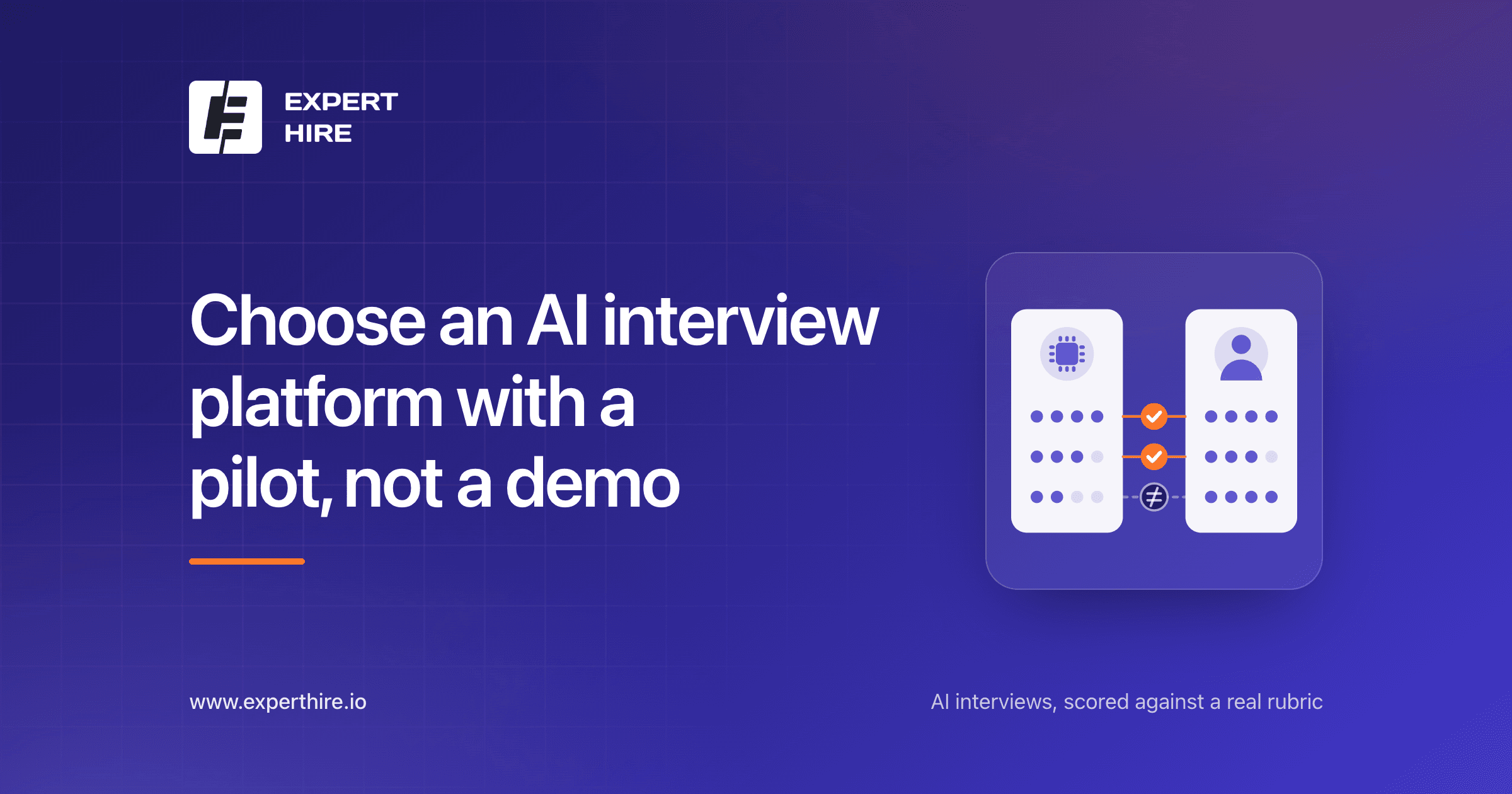
How to choose an AI interview platform comes down to one test: run the same real candidates through each tool on your shortlist and compare its scores with what your best interviewer would have said. A demo can't fail, because the vendor picks the candidate, the role, and the questions. A pilot on your own candidates can, and that's the only kind of evaluation worth your time.
This guide is for employers and recruiters picking a tool that interviews candidates, not for job seekers looking for an interview copilot. Most buying guides here rank tools on interview format, integrations and price, and that's a fine way to build a shortlist. This post is the part they skip: how to run the pilot, what to measure, and which results should end the conversation.
Key Takeaways
Our position: a feature list and a sales demo can't tell you whether an AI interview platform works. A pilot on your own recent candidates can.
Load the same rubric into every tool and have your strongest interviewer score the same candidates blind, then compare agreement criterion by criterion, not on the total.
Five checks matter more than any feature: the evidence behind a score, whether a human can override it, what happens when an integrity flag fires, what the candidate sees, and the adverse-impact picture.
Automated pass or fail, a score with no transcript behind it, and no sample report before a sales call are reasons to end an evaluation early.
Model the price on a real month and on a month where volume doubles, because per-seat, per-assessment and per-workspace pricing reward very different behavior.
Why a feature list won't tell you which AI interview software works
Put any five AI interview platforms side by side and the feature grids look almost identical. They all claim structured scoring, ATS sync, proctoring, and some version of "explainable AI". A checklist rewards whoever wrote the longest list, not whoever scores your candidates the way your team would.
That last part is the real worry. When buyers ask for an AI interview platform comparison, they rarely mean "which one has more integrations". They mean "will this thing rank my candidates the way my best engineer would, and can I defend it when it doesn't". No feature grid answers that.
The research backs the instinct to care about structure over polish. Sackett and colleagues' 2022 reanalysis in the Journal of Applied Psychology found structured interviews were the top-ranked selection procedure, with validity of roughly .42 once older range-restriction corrections were fixed. A platform that runs a structured interview well is worth having, and whether it does that on your roles is something only a test can show.
Decide what job you're hiring the AI hiring platform to do
Before you run anything, be clear which kind of tool you're testing. Some platforms filter: they read resumes and rank documents. Others evaluate: they watch the candidate do the work, in an interview, a coding test, or both. We wrote up the difference between filters and evaluators in AI recruiting software, along with the criteria worth scoring each on, so we won't repeat it here.
Think of that post as what to score and this one as how to test it. If you're replacing a first-round technical screen, every tool in the bake-off has to run an actual first round, live and two-way or recorded, so you can see the difference yourself. Our vendor-by-vendor comparisons are a reasonable place to build the shortlist.
How to choose an AI interview platform with a bake-off, not a demo
Here's the protocol we'd use to evaluate AI recruiting software on a live role. It takes a few weeks, not a quarter.
Pick one live role you hire for often, with a hiring manager who'll engage. Don't pilot on a role you fill once a year.
Choose a fixed set of candidates, ideally a mix of people you hired, people you rejected late, and people you rejected early. Use recent candidates who agree to take part, or new applicants who go through both the tool and your normal process.
Write one rubric with the skills and weightage for the role, and load the same rubric into every platform. If a tool can't take your rubric, note that, because it's a finding.
Have your strongest interviewer score the same candidates blind, against the same rubric, without seeing any AI score first.
Collect every report card, and keep the transcript, recording, or code behind each one.
How many candidates is enough for an AI interview pilot? There's no magic number, and we won't pretend a pilot is a powered study. In practice you want enough that a pattern would be visible, which means a few dozen candidates rather than five.
How to compare AI scores with your own interviewers
The mistake most teams make is comparing total scores. Two tools can both give a candidate 72 out of 100 for completely different reasons. Compare per criterion instead, because that's where you learn whether the tool sees what your interviewer sees.
For each candidate and each criterion, note three things: the AI's score, your interviewer's score, and whether they cite the same evidence. A useful rule of thumb is to count how often the two land within one point on the rubric scale, then read every case where they don't.
Those disagreements are the most valuable part of the whole comparison. Sometimes the AI is wrong, and sometimes your interviewer missed something the transcript proves. Either way, you'll learn more from ten disagreements than from a hundred agreements. Our explainer on how AI interviews are scored covers what a defensible score should be built from.
Five checks every demo skips
These are the questions a demo is designed to route around. Test each one yourself during the pilot.
Evidence. Can a reviewer who disagrees with a score check it using only what's on the report? A score should trace to a transcript line, a piece of code, or an answer. Our guide to reading a candidate report shows what that looks like in practice.
Override. Can a human change the score, and does the tool record why? On Expert Hire, a recruiter can change the AI's score but has to give a reason, and the whole team can see the report, comment on it, and share notes.
Integrity flags. When a proctoring signal fires, does the tool auto-reject, or does it surface the flag for a human to judge? Auto-rejection on a single signal will cost you good candidates.
Candidate experience. Take the interview yourself, start to finish, on a bad laptop and an average connection. If you wouldn't sit through it, your best candidates won't either.
Adverse impact. Look at pass rates across groups in the pilot. The four-fifths rule in the Uniform Guidelines is a first screen, not a verdict, and the same text warns that differences based on small numbers may not mean much.
Regulation turns that last check into a requirement in some places. New York City's Local Law 144 on automated employment decision tools requires a bias audit and candidate notices, and the EU AI Act classifies AI systems used for recruitment and selection as high-risk. Our summary of AI hiring laws covers what each asks of you.
Red flags that should end the evaluation
Some findings aren't trade-offs. They're reasons to drop a vendor from your shortlist on the spot.
No sample report before a sales call. If a vendor won't show you the artifact it produces, assume it wouldn't survive your scrutiny.
A score with no transcript behind it. A number you can't trace is a number you can't defend to a hiring manager, a candidate, or a regulator.
Unexplained pass or fail. Automating the cut is fine at volume, as long as you set the threshold yourself and every rejected candidate has a transcript and a scored report behind the decision. Expert Hire lets you set auto-shortlist and auto-reject thresholds on a round, off until you turn them on, and the report card shows the evidence behind every score.
No bias-audit or compliance documentation if you hire in New York City or the EU.
Pricing that taxes adding a reviewer. If inviting your hiring manager to read reports costs another seat, people stop reading them.
Pricing models: what per seat, per assessment and per workspace each reward
Pricing isn't only a cost question. Each model quietly shapes how your team uses the tool, so model it on a real month before you sign.
Per seat rewards keeping the tool small. It's cheap when one recruiter uses it and expensive the moment you want the hiring manager, the panel, and a client in the report.
Per assessment rewards screening fewer people. It's predictable at steady volume and painful when a role suddenly gets 400 applicants.
Per workspace with a shared usage pool rewards bringing everyone in, since reviewers cost nothing, while usage still scales with volume.
For reference, Expert Hire prices per workspace and never per seat, with unlimited team members. Plans run from Explorer at $99 a month to Starter at $249 and Growth at $499, with Scale on custom pricing, and desktop proctoring is included on Growth and above rather than metered. Whatever you're comparing, run the numbers twice: once on last month's volume and once on a month where it doubles.
Frequently asked questions
How do you decide which AI interview platform to use?
Build a shortlist from comparisons, then run a pilot rather than relying on a demo. Put the same recent candidates through each tool with the same rubric, have your best interviewer score them blind, and compare agreement per criterion. Then check the evidence behind scores, override controls, integrity-flag handling, candidate experience, and adverse impact.
Are AI interviews a red flag?
Not on their own. What should worry you, as a buyer or a candidate, is an AI interview that passes or fails people automatically, or a score with no transcript behind it. A well-run AI interview is a structured first round with a human still making the call.
Can I test AI interview software before buying it?
You should, and on your own candidates rather than the vendor's demo account. Many vendors offer a trial. Expert Hire's 30-day free trial starts with 75 Hire Credits, which covers about 15 AI interviews at 5 credits each, enough to test one live role before you size a full pilot.
What features should I compare in an AI interview platform?
Compare the evidence behind each score, whether a human can override it with a recorded reason, how integrity flags are handled, what the candidate experiences, and how the pricing model behaves as volume grows. Integrations and dashboards matter less than whether the scores hold up on your roles.
How many candidates does an AI interview pilot need?
There's no fixed number, and a pilot isn't a statistically powered study. Aim for enough candidates that a pattern of agreement or disagreement would be visible, which in practice means a few dozen rather than a handful, and include people you hired as well as people you rejected.
Make every vendor fail on your candidates first
The best way to choose an AI interview platform is to give each one a fair chance to fail. Load your rubric, run your candidates, and compare the scores with your best interviewer's, criterion by criterion. Whichever tool survives that, and shows its evidence when it disagrees, is the one worth buying.
When you want to put us through the same test, start a 30-day free trial from the Expert Hire pricing page and run your pilot on a live role.
By TK, Growth at Expert Hire. Last updated October 6, 2026. Reviewed by Anand Suresh, CPO at Expert Hire.
Ready to Transform Your Hiring?
Start your free trial to see how Expert Hire can help you screen candidates faster and smarter.