Work sample test: examples, scoring, and what the evidence really says
A work sample test is a hiring assessment where the candidate performs a task that mirrors the real job, like writing a short function, answering a tricky support ticket, or cleaning a messy dataset. Instead of asking people to describe their skills, you watch them use those skills on something close to the actual work.
Work samples are still one of the best tools you have. They just aren't the "single best predictor" most of the internet keeps quoting, and that changes how you should use them. Pair the task with a structured conversation about it, and you get the best of both.
Key Takeaways
Our position: work samples are useful, but the 2022 validity update puts structured interviews first. Run the task, then ask structured questions about it.
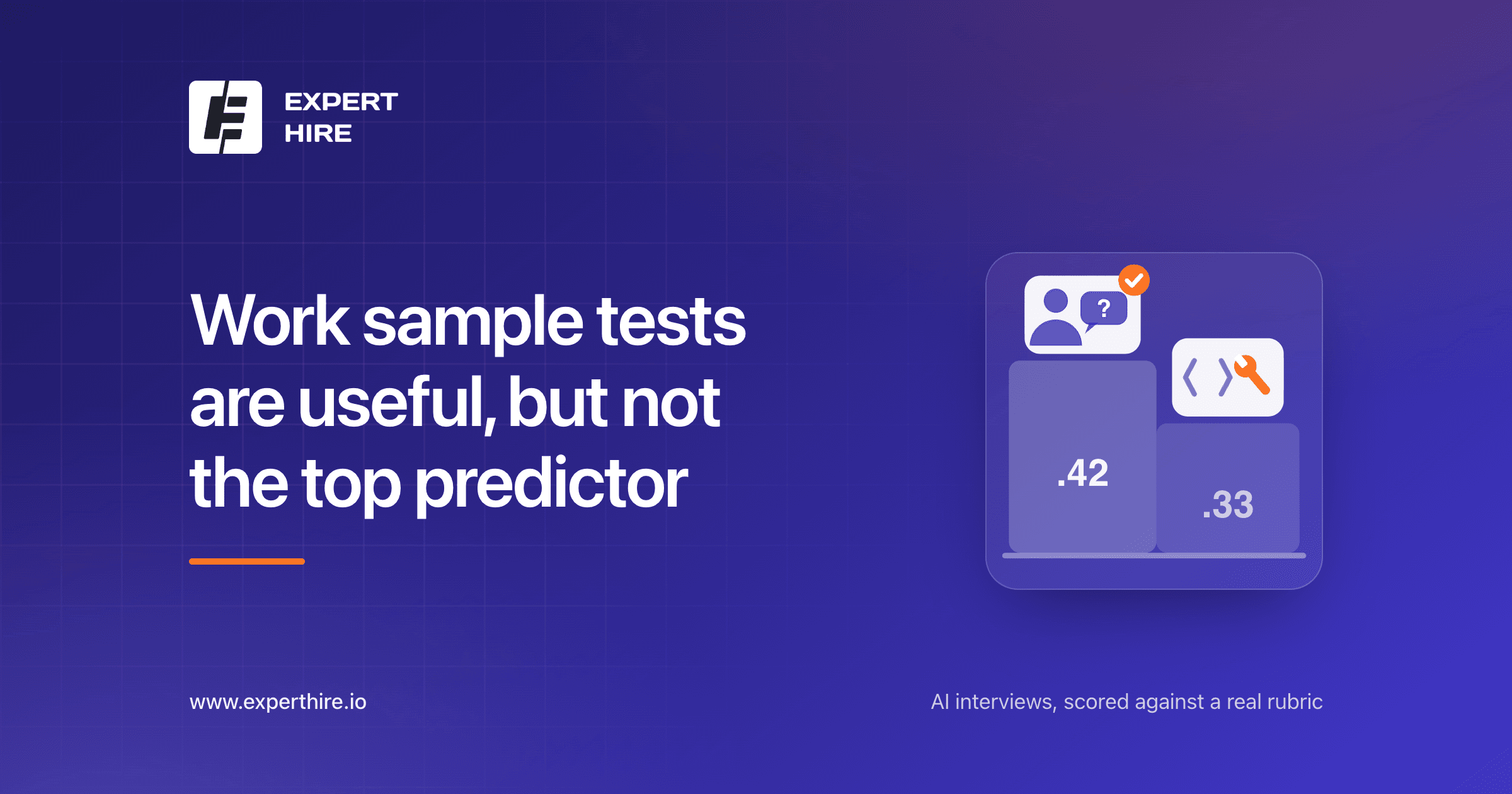
Sackett and colleagues revised work sample validity down by about .21, to roughly .33, while structured interviews sit at about .42.
Work samples suit experienced hires. They're a weak fit for entry-level roles where the skills get learned after hire.
Write the scoring criteria before anyone submits anything, and use anchored levels rather than a gut-feel score.
An unsupervised work sample now measures the candidate plus an AI assistant. Either allow it and score the reasoning, or run the task somewhere controlled.
What a work sample test is
The US Office of Personnel Management describes work samples and simulations as assessments where candidates perform tasks similar to those on the job. Its own example is an administrative assistant applicant transcribing a memo or filing a stack of paperwork. The idea is that the test looks like the work because, in a small way, it is the work.
You'll also see it called a work sample assessment or a job simulation test. The labels vary, but the principle doesn't. You're sampling real job behavior instead of inferring it from a resume, a personality score, or a confident answer in an interview.
That's why work samples sit at the center of skills-based hiring. Test the skill, don't trust the label.
Work sample test validity: the 2022 correction
For decades, vendor pages have called work samples the single best predictor of job performance. That claim comes from Schmidt and Hunter's 1998 meta-analysis, and it's out of date.
In 2022, Sackett, Zhang, Berry and Lievens revisited the validity estimates behind those rankings. They found that earlier work had overcorrected for range restriction, which inflated the numbers. The procedures that ranked high before mostly stayed high, but their mean validity estimates fell by .10 to .20, and structured interviews came out as the top-ranked procedure.
The same authors' 2023 follow-up spells out what that means for work samples. Work sample validity came out .21 lower than the old figure, which leaves it at about .33, tied for fourth once the authors revised assessment centers up to the same value. Structured interviews top the list at about .42.
So the honest read is this. Work samples still predict performance, and the authors stress that selection procedures remain useful. But a work sample on its own is no longer the gold standard, and a structured interview about the work beats the task alone.
When a work sample test is the right tool, and when it isn't
The same 2023 article makes a point almost nobody repeats. Work samples and job knowledge tests aren't generally applicable to entry-level hiring when the skills get developed after hire. You can't sample work someone hasn't learned to do yet.
Here's how we'd use that:
Experienced hires: a work sample is a strong fit. The skills should already exist, and the task shows them directly.
Entry-level and trainee roles: use structured interviews about learning, motivation and judgment instead. A work sample will mostly measure prior exposure.
High-volume roles: keep the task short and scoreable, or reviewers will drown and standards will drift.
Senior and leadership roles: use a discussion-based exercise, like a plan or a case, and spend most of the time on the conversation about it.
Job-relatedness also matters legally. The Uniform Guidelines on Employee Selection Procedures treat a selection procedure with adverse impact as discriminatory unless it has been validated. A task that clearly mirrors the job is far easier to defend than one that doesn't.
Work sample test examples by role
Ready-made tasks are hard to find, so here are work sample test examples for hiring across common roles, each with a time box and what strong looks like.
Software engineer (45–60 minutes): fix a bug and add a small feature in an unfamiliar codebase. Strong looks like a minimal, tested change and a clear note on what they'd do next.
Data analyst (60 minutes): answer three business questions from a messy CSV. Strong looks like correct numbers, stated assumptions, and one chart that actually answers the question.
Customer support (30 minutes): reply to three real tickets, including one angry customer and one unclear request. Strong looks like accurate answers, the right tone, and a good clarifying question.
Sales (30 minutes): write a first outreach email to a named account, then handle two objections. Strong looks like specific research, one clear ask, and calm objection handling.
Marketing (45 minutes): rewrite a weak landing-page section and explain the changes. Strong looks like a sharper message for a defined reader, with reasons.
Recruiter (45 minutes): write a job post from intake notes and screen three sample resumes. Strong looks like must-haves separated from nice-to-haves, and decisions with reasons.
Operations or admin (30 minutes): schedule a week of meetings around conflicting constraints. Strong looks like nothing double-booked and the trade-offs flagged.
Product manager (60 minutes): prioritize five feature requests and write a one-page brief for the top one. Strong looks like clear criteria and a brief an engineer could start from.
These are methods you can run with your own materials. Use real, anonymized work where you can, and keep every task inside the time box you state.
How to design one: the task, the time box, the materials
Start from the job, not the test. List the three to five tasks that make up most of the role's real work, then pick one that's central, observable and short enough to finish. If a task needs company-specific knowledge, give candidates that context up front.
Keep the time box honest. Most of the examples above run 30 to 60 minutes, and that's on purpose. Long unpaid tasks push out good candidates with other options, and length doesn't add much signal.
Give everyone identical materials and instructions. Say what tools are allowed, including AI. If the task is longer than an hour or looks like real product work, pay for it.
How to score a work sample test without gut feel
How to score a work sample test comes down to one habit. Decide what good looks like before anyone submits anything.
Pick three to five criteria tied to the job, for example accuracy, judgment, communication and speed.
Write anchored levels for each one. Describe what a weak, adequate and strong answer looks like in plain words, so two reviewers reach the same score.
Use two reviewers or a calibrated rubric. Compare scores on the first few submissions and talk through gaps before you score the rest.
Score blind to the resume where you can, so the task is judged on its own.
Finish with a structured conversation. Ask every candidate the same questions about their choices: why this approach, what they skipped, what they'd change.
That last step is where the 2022 findings pay off. The task shows output, and the structured follow-up adds the method that ranks first. Our guide to structured interview software covers how to run those questions consistently.
Work samples when every candidate has an AI assistant
An unsupervised work sample now tests what the candidate and an AI assistant can do together. For many roles that's fine, because that's how the job will be done. But you need to decide on purpose, not by accident.
You have two honest options. Allow AI, say so, and score the reasoning in the follow-up conversation. Or run the task in a controlled environment where the work happens in front of you.
Expert Hire covers two technical work samples as part of first-round screening. Coding tests run the candidate's code in a sandbox against hidden test cases and score it on correctness, efficiency and code quality. The prompt assessment has candidates write prompts for real tasks, scored on 8 dimensions including prompt quality and iteration strategy.
Both land on the same report card as the AI interview, scored against the skills and weightage you set. Auto-shortlist and auto-reject thresholds are opt-in and off by default, so there's no black-box pass/fail. For general context on how these fit with other test types, see our overview of the pre-employment assessment options.
Frequently asked questions
What is a work sample test?
A work sample test is an assessment where a candidate performs a task taken from the real job, such as fixing a bug, answering support tickets, or analyzing a dataset. It shows the skill directly instead of asking the candidate to describe it. It works best with clear scoring criteria and a structured follow-up conversation.
What is an example of a work sample test?
A customer support candidate replying to three real, anonymized tickets in 30 minutes is a classic example. Others include a data analyst answering business questions from a messy spreadsheet, or a recruiter writing a job post from intake notes. The task should mirror the work the person will actually do.
Are work sample tests valid predictors of job performance?
Yes, but less than older sources claim. Sackett and colleagues' 2022 and 2023 work puts work sample validity at about .33, tied for fourth, while structured interviews rank first at about .42. Work samples are still useful, especially when you pair them with structured questions about the work.
What is the difference between a work sample and a portfolio?
The work sample vs portfolio difference is control. A portfolio shows past work the candidate chose, made under conditions you can't see, often with a team. A work sample is a task you set, under the same conditions for everyone, so you can compare candidates fairly.
How long should a work sample test take?
For most roles, 30 to 60 minutes is enough to see the skill. Longer tasks add little signal and push away candidates with other options. If a task needs more than an hour or produces work you could use, pay the candidate for their time.
The bottom line on work sample tests
A work sample test is still one of the most job-relevant things you can ask a candidate to do. Just don't treat it as the single best predictor. Use it for experienced hires, score it against criteria you wrote first, and always follow it with structured questions about the work.
If you want technical work samples that actually execute and land on one report card with the interview, see how Expert Hire coding tests work.
By TK, Growth at Expert Hire. Last updated October 13, 2026. Reviewed by Anand Suresh, CPO at Expert Hire.
Ready to Transform Your Hiring?
Start your free trial to see how Expert Hire can help you screen candidates faster and smarter.